A survivor’s voice
Holocaust survivor, John Hajdu MBE features in HMDT's latest video which confronts the stark reality that every year, there are fewer Holocaust survivors able to share their life stories firsthand.
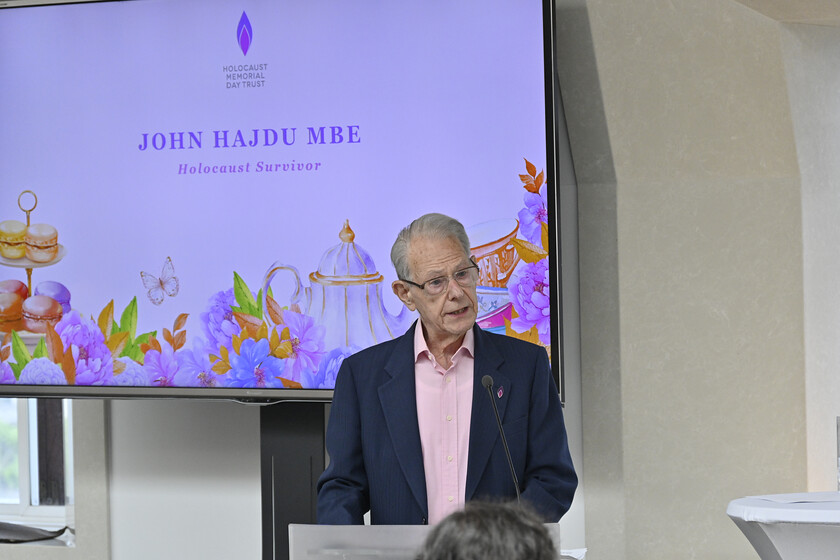
Holocaust survivor, John Hajdu MBE features in our new fundraising film which conveys the urgent importance of Holocaust education at a time of an alarming rise in antisemitism, as well as Holocaust denial and distortion. John Hajdu reflects this message clearly: “The time for me to tell you about my experiences as a Holocaust survivor is running out.” We spoke to John about the film.
You appear in the latest fundraising film from the Holocaust Memorial Day Trust. Why do you feel projects like this are so important?
The fundraising film is a very strong tool in our armoury to fight antisemitism in any way we can. The HMDT theme next year is ‘No Place for Prejudice’. We all must make every effort to pass on this message.
Why has Holocaust education become such an important part of your life?
We, the survivors, must make every effort, while we still can, to pass on the message that the Holocaust must never be forgotten. I consider it my duty to do so. First-hand testimony is vital as is the education of future generations, who hopefully will pass on our message in their classrooms, and in the diverse communities I address, and I feel an enormous responsibility to share my experiences. My son, who has accompanied me to several of my talks, has decided to start giving talks based on listening to my experiences.
John Hajdu is a survivor of the Holocaust in Hungary and lived under the subsequent socialist regime in Budapest. Having lived in the UK since 1957, John’s experiences of life after the Holocaust and as a refugee tell of the turmoil of post-World War Two Europe.
Could you tell us about your early childhood?
I was born in Apri 1937 in Budapest Hungary. My grandfather and father were both directors in the insurance business and my mother was a bookkeeper. We lived a comfortable, peaceful and relatively safe life in a part of Budapest. A total of 450,000 Jews lived in Hungary, with 23,000 living in the capital.
How did life change for Jewish families as the Second World War unfolded?
The Hungarian government decided in 1939 to prohibit Jews from owning or running their companies. This was the first sign that the lives and movements of Jews will become much more restricted.
In 1941, Hungary entered the war as an ally of Nazi Germany. In a remarkably short time everything changed. Many anti-Jewish laws were passed by Parliament, excluding Jews from various professions or from working in the civil service. Jews were prohibited from entering hotels and restaurants or using cars, taxis or trains. From that time, life for Hungarian Jews became more and more dangerous and prominent antisemitism took hold.
In 1943 forced labour camps for Jewish men were set up all over the country and my father was taken to such a place. They had to undertake heavy physical labour and were given very little food. They were treated very badly, some became ill and many died.
What happened when the Germans occupied Hungary in 1944?
On 19 March the Germans occupied Hungary and marched into Budapest. On the 5 April the “yellow star order” was given and all Jews had to wear a six pointed yellow star as a mark of identification. This resulted in constant abuse and if you did not wear one you could be killed. On the 15 June 1944, we were ordered to leave our home and had to move into a yellow star block of flats, which was identified by a yellow star on the front entrance. We were allowed out only for a couple of hours in the afternoon to buy basic items of food, with the yellow star on our clothing. The gates were locked at night. I had no toys or books and could not meet other children. I was completely isolated. We were not allowed to visit parks, sport facilities or cinemas.
Can you tell us about your mother’s deportation and how you escaped?
At this time all Jewish properties were confiscated and between May and July 1944, 400,000 Jews were deported and on the 13 October at 6am this included my mother, who was taken to Mauthausen concentration camp in Austria. My aunt who stayed with us, grabbed me and begged a neighbour to hide us, which fortunately he agreed to do, so we escaped being deported. It was a frightening experience for a small boy.
What was life like in the Budapest Ghetto?
Due to more stringent searches, we had no choice but to move into the Ghetto, where 65,000 Jews who were not take to concentration camps, were herded into 4,500 flats with at least 15 of us in each flat. There was no electricity, no water to have a bath or shower, water had to be brought up in buckets. No medicine, no cleaning material and no rubbish was collected. Dead bodies lay piled up on the street, having died of cold, starvation or from various diseases. Around 80 people died every day. It was not advisable to go outside. I did not know anybody in the flat, there were no other children, no books or toys and no privacy. At the same time, I had no idea what happened to my mother and father, or if they had survived.
John’s testimony is a reminder of courage and resilience. You can read more about John’s life during and immediately after the war: Holocaust Memorial Day Trust | John Hajdu MBE
To support our work, please donate if you can. Thank you for your generosity.