The Stanislaw Brunstein Society – Exhibition – HMD 2026
Activity information
Activity type: Public activity
Organisation name: The Stanislaw Brunstein Society
Website: https://valentinesmansion.com/event/memory-to-memorial-from-warsaw-to-valentines/
Address:
Valentines Mansion
Emerson Road
Ilford
LB Redbridge
IG1 4XA
United Kingdom
Memory to Memorial: From Warsaw to Valentines. The Stanislaw Brunstein Society
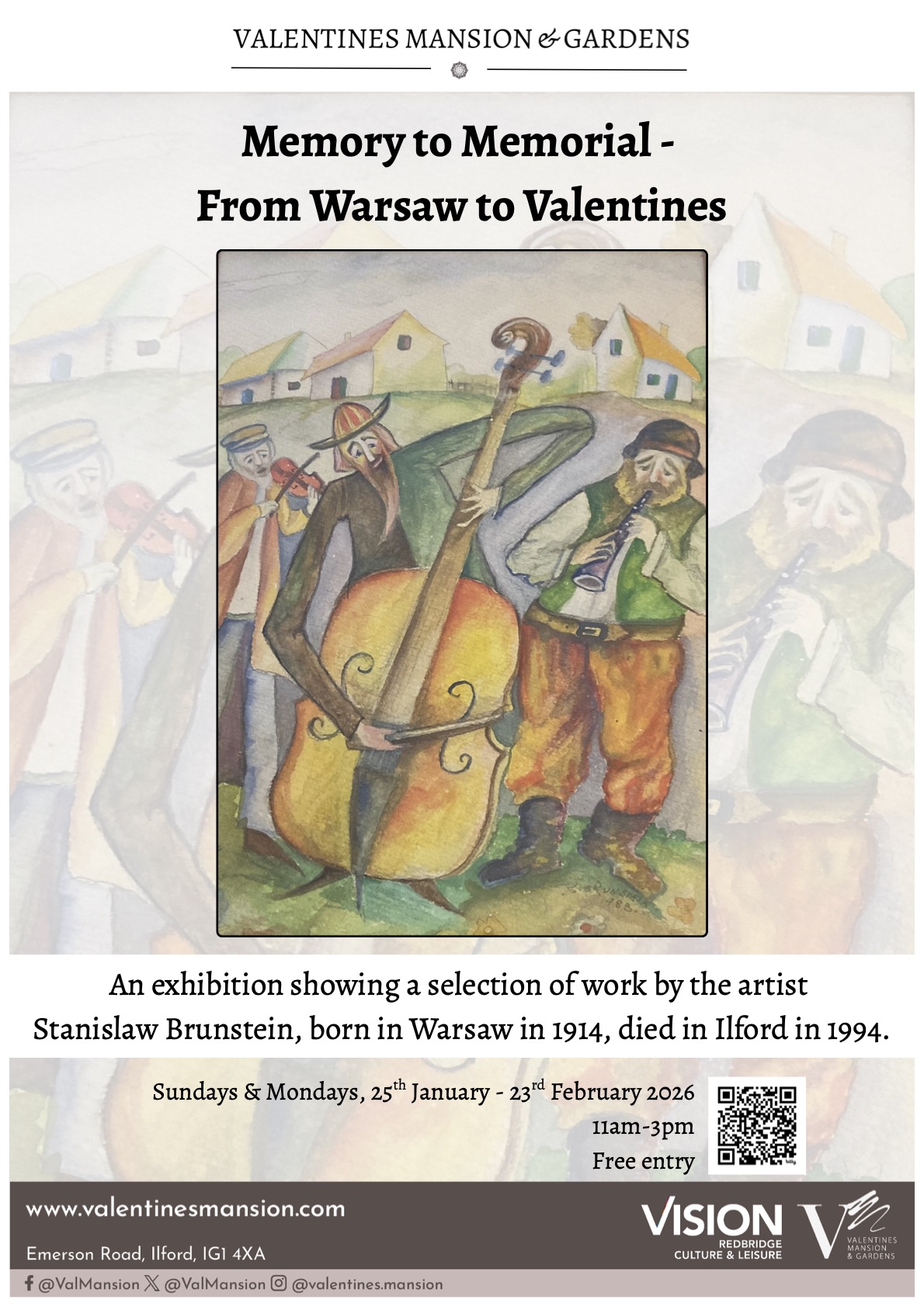
An exhibition showing a selection of work by the artist Stanislaw Brunstein, born in Warsaw in 1914, died in Ilford in 1994.
These paintings will take you on the artist’s journey from his beloved Warsaw to post war England, via escape into Soviet Russia, prison, slave labour in Siberia, army service in North Africa, and the Battle of Monte Cassino in Italy, whilst also having studied fine art in Warsaw, Paris and Rome. His final destination was a house in a street five minutes away from the location of the exhibition in Valentines Park.
The exhibition is hosted at Valentines Mansion Ilford IG1 4XA by Vision Redbridge Culture and Leisure. In addition to Holocaust Memorial Day, the exhibition is open Sundays and Mondays from 25th January 2026 to 23rd February 2026 between 11am and 3pm. The exhibition is supported by a site on the Bloomberg Connect app, which also has examples of Stanislaw's other work and an appreciation of his life.
The exhibition presents some 30 examples of Brunstein's work which depict his memories of pre-war Jewish life in Poland and of his wartime experiences. The works are supported by writings produced by his daughter which talk of her father's life and work and of her own experience as a second generation survivor.
Who was Stanislaw Brunstein?
Stanislaw Brunstein was born in 1914 in Warsaw to a Jewish family who owned a dairy. He was an only child and his mother, in particular, cosseted her son.
He showed talent as an artist and he studied at the Warsaw Academy of Fine Art. It was there he experienced first hand the antisemitism that was rife in Poland. As a Jewish student he was singled out and expected to stand for the duration of his classes.
He matriculated in 1936 and went on to further studies in L’Ecole des Beaux Arts in Paris.
On returning to Warsaw he worked as a freelance satirical cartoonist for Polish and Yiddish Publications as well as stage designer for the Yiddish Theatre.
In 1939 as the Nazis prepared to invade, he fled into Soviet occupied Poland, where he is known to have continued his work In Bialystok, Lvov and Minsk.
In 1940 he was arrested and imprisoned without trial by the Russian secret police. He spent 14 months in solitary confinement in a Red Army prison. He was then sentenced to several years hard labour in a slave labour camp in Siberia, but was released after Russia entered the war and joined the allied forces. Stanislaw joined the Polish army under General Anders, fighting in North Africa, Persia and Palestine and culminating in Italy at the Battle of Monte Cassino where he was a radio signals
operator. After the war ended he continued art studies in Rome.
Upon realising he was the only surviving member of his entire family, his parents having been murdered in the gas chambers of Treblinka extermination camp, he had no desire to return to a country that was no longer home for him. So he came to England, finding work as stage designer for the Yiddish Theatre in the East End of London. Here he met his wife to be, Esther Zylberberg, who was an actress on the Yiddish stage. She was also a Holocaust survivor, of the Łódź Ghetto, Auschwitz and Bergen Belsen concentration camps.
Stanislaw did a course in tailoring and cutting and started a small business in designing and producing children’s wear.
They had two daughters, Lorna and Denise. In 1956 the family moved to Ilford, then an Essex suburb.
After the war he was hardly painting but he recommenced his own art work in 1962 after a serious bout of pneumonia, expressing himself through his memories of Jewish community and religious life and loss in pre-war Poland.
His first major exhibition was at Oaks Lane Synagogue, Newbury Park, nearly sixty years ago. Many other exhibitions followed, both in this country and abroad. He sold many works and some of his paintings are held in collections at the Ben Uri Gallery and at the National Holocaust Museum.
Stanislaw Brunstein continued painting until he died in 1994.
Organiser Name
Other organisation(s) involved
Vision Redbridge Culture and Leisure