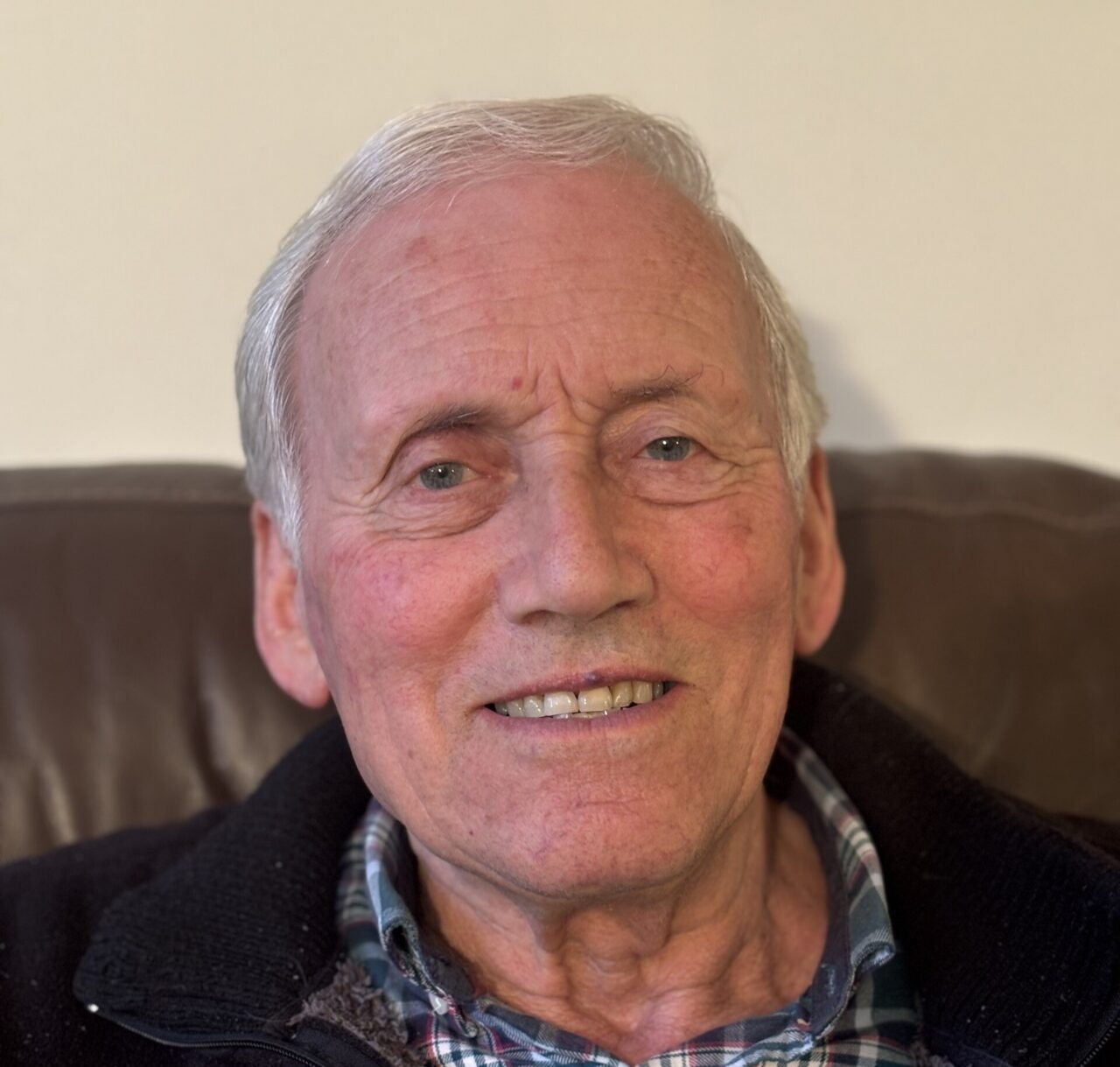
Robert Slager
Robert Slager was born in Amsterdam in August 1943 to Lena and David Slager. Although the Netherlands had remained neutral at the beginning of the Second World War, Nazi Germany invaded the country in 1940 and subsequently occupied it. From then on, increasingly restrictive antisemitic laws and measures were introduced, severely limiting the rights and freedoms of Jewish people.
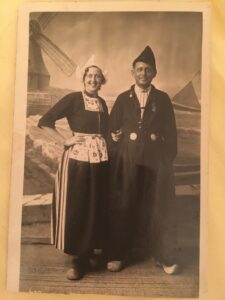
Lena and David Slager in traditional Dutch dress
Compared with other occupied countries, such as France and Belgium, the Netherlands experienced a particularly devastating loss of its Jewish population during the Holocaust, with 70% of the Dutch Jewish population deported. During the Nazi occupation of the Netherlands, around 28,000 Dutch Jews went into hiding.
Only a few weeks before Robert was born, his father David Slager was deported to Auschwitz where he was killed. Robert’s mother, Lena Jacobs, narrowly escaped deportation herself. While she was pregnant, she and her family were taken to a railway station and were about to be deported to concentration camps. However, when Lena gave her name, she was told it did not appear on the list. This administrative mistake saved her from deportation and probable death.
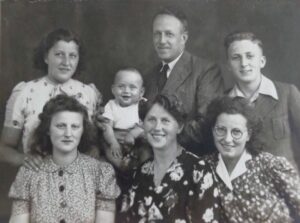
Robert and the Bakel family
Robert was born secretly in a clinic in Amsterdam where Jewish women gave birth during the war. Only a week after his birth, members of the Dutch resistance arranged for him to be taken to Delft, where he was placed with the Bakels family. The newborn arrived in a suitcase, with the name “Robert” written across his chest on his clothes.
The Bakels family hid Robert throughout the war and raised him as their own child. He attended church with them every week. They were members of the Protestant Church and, motivated by their Christian faith and their connections to the resistance, decided to hide a Jewish child. According to Robert, it was the Bakels’ belief that “human beings should save other human beings in danger”. Since people in the town became aware that the Bakels were hiding a Jewish child, the family soon moved further north to Groningen for greater safety. Robert’s years with the Bakels family were loving and secure. They treated him as their own son, and he regarded them as parents.
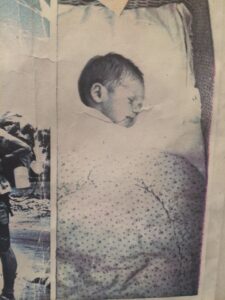
Robert as a newborn
Meanwhile, Robert’s mother went to Gouda, near Rotterdam, where she worked as a housekeeper for various families under a false identity. After the war, she began searching for her son, travelling by bicycle with no tires, as the Nazis had taken all rubber for use in factories. She travelled by this bicycle across the Netherlands and asking people if they knew of his whereabouts.
In 1948, Lena’s search finally led her to Groningen, where she met a man who told her that his brother had hidden a young Jewish boy during the war. The man was the brother of Robert’s foster father. Lena travelled to the farm, where she identified Robert by his name and a distinctive birthmark she remembered. When Robert found out that his birth mother was alive, he was so excited to have two mothers. For the next six months, she visited him regularly before eventually bringing him back to Amsterdam at the age of five. Hidden children being reunited with their families did not always have a happy reunion. Robert was lucky that his relationship with his mother Lena strengthened after such a long time apart.
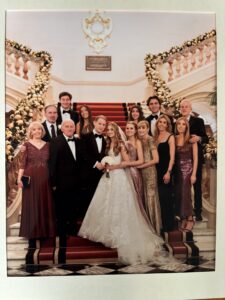
Robert Slager and family
Returning to live with his mother did not mean that Robert lost contact with the Bakels family. He remained close to the Bakels and continued to regard them as part of his family. When Robert was officially registered in Amsterdam, his mother added the name “Bart” as his second name, after his foster father, as a sign of gratitude.
In Amsterdam, Robert went to a Jewish kindergarten and later primary school, thus becoming part of the Jewish community. Although he was involved with the Amsterdam Jewish community, Robert rarely spoke about his experiences either with his mother or with other children.
Robert became involved in Holocaust education at the age of seventeen, when he began working as a guide at the Anne Frank House in Amsterdam, the former hiding place of Anne Frank. One day, on a tour of the museum, he showed Otto Frank, Anne’s father, around. Although Robert was nervous about showing Otto around the place where he had once been hidden, Otto praised his skills as a guide. Robert explained that he could relate to Anne because he, too, had experienced life in hiding. The two remained in close contact for many years and stayed good friends.
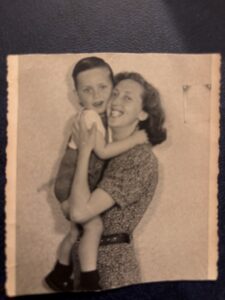
Roberts reunion with his mother
In 1966, in his early twenties, Robert started working in the metal trade and moved to London for a job opportunity. It was there that he met his wife, Monique. Neither Robert nor his wife had any parents at their wedding. Unfortunately, Lena passed away a few years prior. The Bakels were the only family in attendance at their wedding. The newlyweds moved back to Amsterdam, where their daughter Rina was born. They then moved back to London to be a part of a larger Jewish community. In London, their children, David and Ilana, were born.
After moving to London in 1975, Robert met Eva Schloss, Otto Frank’s stepdaughter and a fellow Holocaust survivor. Eva encouraged him to share more of his experiences as a hidden child and to become more actively involved in Holocaust education. The Slager family has remained in London ever since, and Robert and his wife are fortunate to have seven grandchildren. Robert is also actively involved with the Holocaust Survivors’ Centre.
Although the Bakels never received any formal recognition for their actions, their decision to hide Robert was an act of courage and solidarity that ultimately saved his life.