Isa Brysch
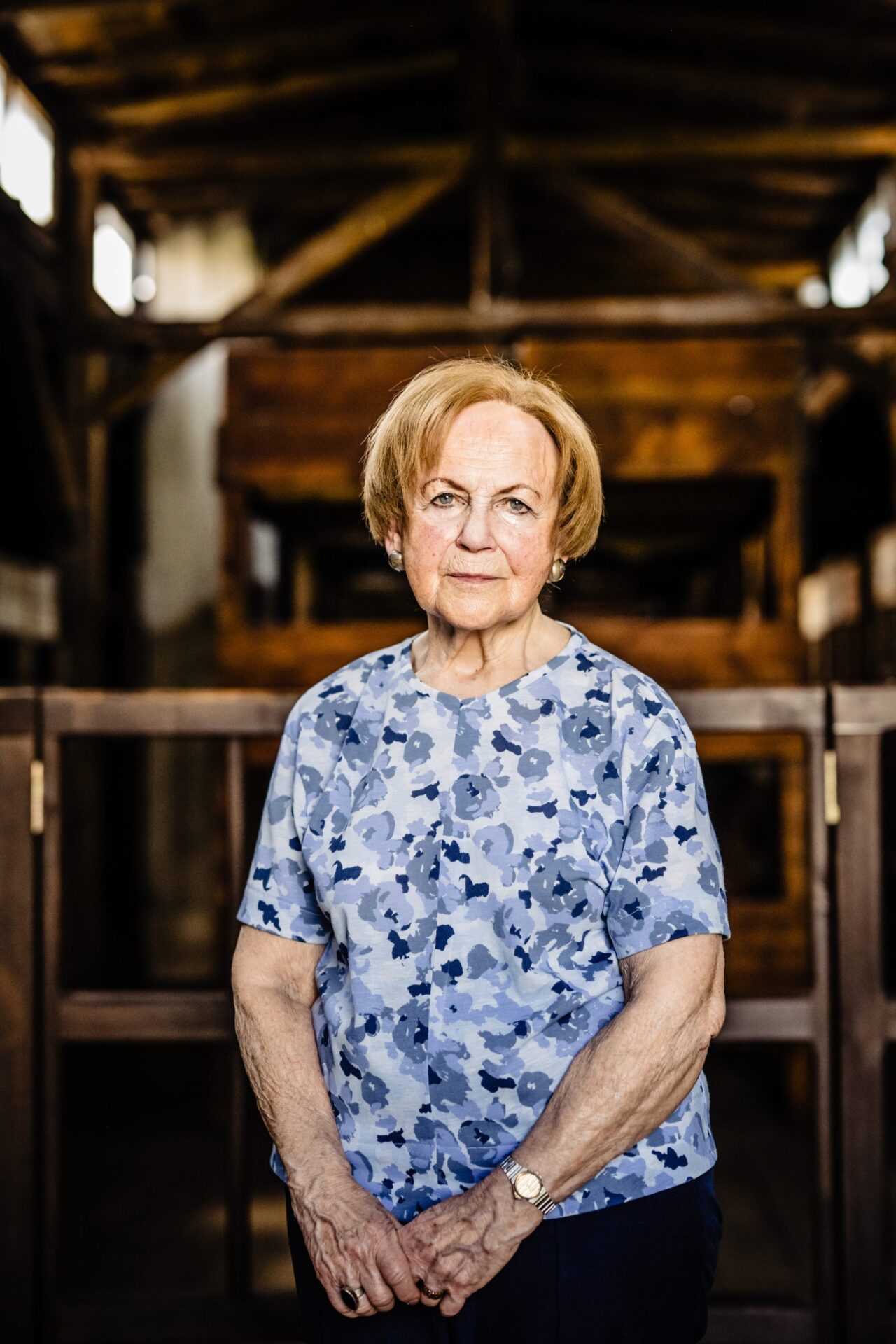
Isa Brysh, nee Stern, was born into a Jewish family in Heilbronn am Neckar, Germany, on 22 June 1929. As a child, she fled Nazi persecution, travelling through France, Spain and Portugal before eventually reaching safety in Britain. Unlike many Jewish children living under Nazi occupation, Isa never wore the yellow Star of David. Despite years of displacement and uncertainty, Isa and her immediate family all survived the Holocaust. However, her maternal grandmother died in Theresienstadt, and her paternal grandmother was murdered in a Nazi gas van.
Isa’s parents, Paula and Alfred, and grandparents and great-grandparents were German citizens who had lived in Germany all their lives. Her family was fully integrated into German society, with her grandfather and great-grandfathers both serving in the German military and receiving medals for bravery. Isa enjoyed a comfortable, middle-class upbringing until 1933, when Adolf Hitler and the Nazi Party came to power. As antisemitic laws and restrictions increasingly excluded Jewish people from German society, life became more difficult for Isa’s family. In 1935, her father was relocated by his firm to France for work. Because it was too dangerous for him to return to Germany; the family would meet up from time to time in neutral Luxembourg.
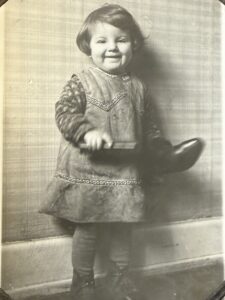
Isa as a toddler
Isa, her mother and her sister later moved to Saarbrücken, near the French border. It was here that Isa first experienced Nazi persecution. At her Jewish school, in the local synagogue, male teachers began disappearing, although at nine years old, she did not fully understand what was happening. Later that year, Nazi SS young ‘hooligans’ ransacked the family’s apartment.
On 10 November 1938, following Kristallnacht (the November Pogrom) Isa recalls standing with her mother on the banks of the river Saar and seeing the red glow of fires from the burning synagogue. Soon afterwards, Paula received visas for the family to join Alfred in Paris. Isa and her sister were enrolled in a Jewish day school and began adjusting to life in Paris and learning French. Because of Isa’s persistent ill health, a Jewish charity offered to provide a recovery trip to Switzerland during July-August 1939. Isa was sent to stay in Geneva with a Jewish family, the Pintos, who would later in the war play an important role in helping the family to put them into contact with one another.
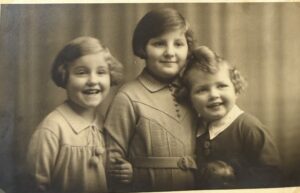
Isa, her sister and cousin
When war broke out, Isa’s father joined the French Army, while Isa and her sister were evacuated with the French Jewish Scouts. Conditions were difficult, particularly during the hard winter of 1939-40, when they slept on straw mattresses and endured lice, fleas and inadequate sanitation. Unbeknownst to the girls, their mother, who had remained in Paris, was detained by the French police. She was kept in the Vélodrome d’Hiver, used as an internment camp for ‘enemy aliens’ before being sent to concentration camps. In a miraculous turn of events, Isa’s mother explained to the Commandant of the camp that she was the wife of a soldier fighting for France and was released from the camp where otherwise she would have been sent to her death. By coincidence, that very day, she met up with her girls who had returned from their evacuation.
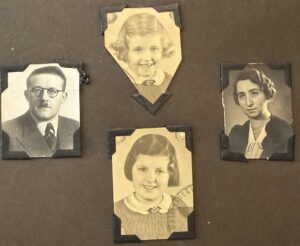
Family passport photos
As German forces advanced towards Paris, Isa’s mother decided that the family needed to flee again. The whole of Paris was ‘emptying out’ to try to move South and it was sheer chaos! With great difficulty and with as much as they could carry, Paula managed to take her daughters out of the city on foot, on trucks, vans and by train, eventually reaching Beaulieu-sur-Dordogne, a small village in southern France. Meanwhile, Isa’s father escaped during the Dunkirk evacuation to Britain, where he later joined the British Pioneer Corps, part of the British Army. By writing to the Pinto family in Switzerland, the family re-established contact and found out where they were.
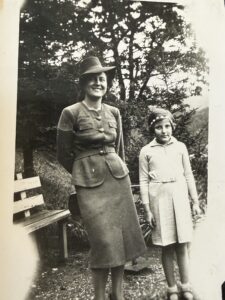
Isa and Mrs Pinto
For the next two years, Isa, her mother and sister remained in hiding in France and went to school in the village. During this time, her father worked with the authorities in Britain to secure the necessary documents for them to join him. Isa’s mother went to an authority in Marseilles where exit visas were being issued. She received some documents that turned out to be forgeries. In February 1942, with great difficulty, they made their way over the Pyrenees, travelling through Spain and Portugal. When in Lisbon, they were detained; the officers would not accept their entry because Paula and the girls did not have exit visas. So, they had to wait in Lisbon until it was somehow sorted out. The plane they were meant to fly to England with was shot down. Luckily, the family were not on that plane! After some time, once a guarantee of safety had been established for their entry into Britain, they flew on a diplomatic plane, landing in Bristol on 19 February 1942. After years of separation, the family was reunited in Britain.
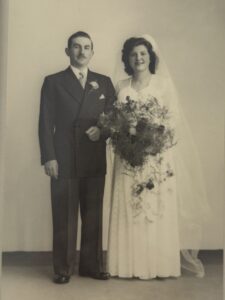
Isa and Abraham on their wedding day
Mother and daughters settled in London. Soon the girls had to be re-evacuated due to the Blitz. Not speaking a word of English, it became very difficult for them when they were sent to a Catholic school, but fortunately their father obtained places for them in a Jewish school evacuated to Shefford in Bedfordshire, which had Jewish refugees as teachers.
In 1945, Isa returned to London to finish her education and take her end-of-school exams. After that, Isa joined her family who had settled in Gateshead. Here her family established a factory producing Kosher crisps, supplying Jewish students and communities across Britain.
She attended the Jewish seminary for teachers in Gateshead and later the teacher-training college in Sunderland, where she gained her teaching qualifications. In 1950, she married Reverend Abraham Brysh, a Holocaust survivor who had been in several camps, the last of which was Auschwitz-Birkenau.
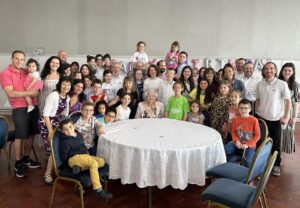
Isa at her 95th birthday party with many members of her immediate family
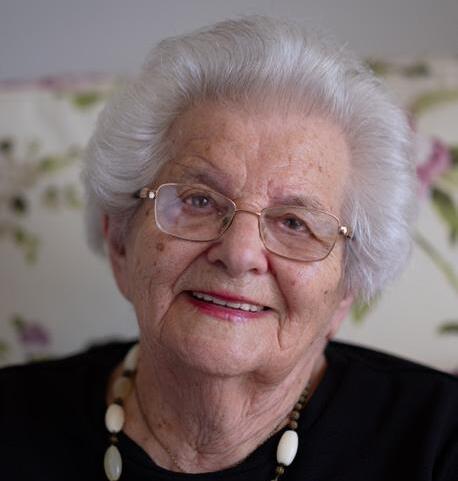
Together, they served as a ministerial couple to the Jewish community in Whitley Bay, and then in Swansea, South Wales where their daughters Helen and Rosalyn were born. They then served in Edinburgh, where their son Henry was born, and finally in Sheffield. They retired to Bournemouth and Isa moved to London in 2020, three days before lockdown. Isa is a grandmother, and a great-grandmother to 57 and an ever-increasing and loving family totalling almost 100.
Isa has dedicated much of her life to sharing her own experiences with school children and adults. She has taught in Jewish religion classes, served in education committees, and been involved in Jewish communal life wherever she has resided. Isa is a regular member at the Holocaust Survivors Centre.